Mt. Baker

Mt. Baker
Fire lookout, Mt. Baker, WA - Oct. 2013

Tuesday, May 19, 2026

An Insightful Experience Hearing “Voices from North Korea” at the University of Washington

This is my reflection originally posted on the Global Peace Foundation website.
  

As a simple handyman living in the Seattle area, attending an event titled “Voices from North Korea” seemed like it might go over my head or be hard to relate to, since the speakers and topics being
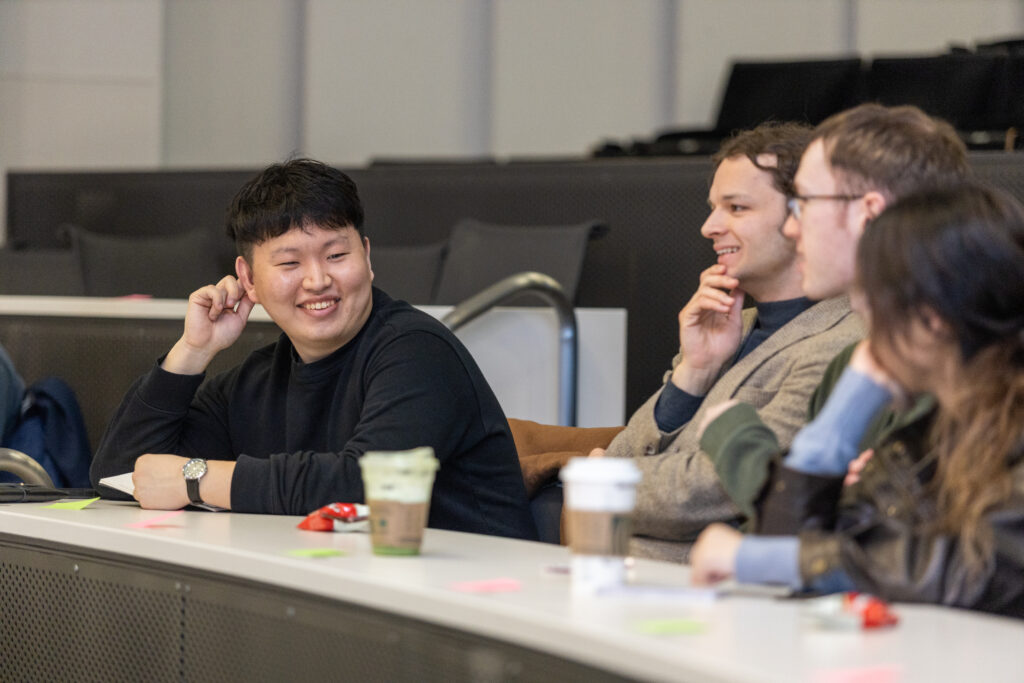
Audience at the AKU “Voices from North Korea” event at the University of Washington.

discussed were from such a foreign land compared to the one I am living in. However, based on my prior engagement with one of the partnering organizations, Global Peace Foundation, I knew that while the harsh circumstances faced by North Koreans would be very different from the abundance we have in the United States, the aspirations of North Koreans to create a better world based on the ideals of freedom, human rights, family values, and service would likely be highly relevant to my own pursuits. By the end, I was pleasantly surprised by how much my assumption was confirmed and how much I gained personally from attending.

Walking through the entrance to the venue at Paccar Hall at the University of Washington on April 1, it was stunning to see the magnificent lobby with high ceilings and modern architecture that seemed to exemplify the epitome of Western civilization, built on the high ideals of God-given freedoms and unalienable human rights. It seemed like the ultimate contrast to the life portrayed by the North Korean escapees, most poignantly by Ms. Jihyang Kim, who described her experience being detained in a tiny cell with more than 20 other prisoners as punishment after one of her attempts to escape amid a famine. In the crowded cell, she was constantly monitored by a surveillance camera, even while using the openly visible toilet at the back of the cell. She ended up fasting for over a week and becoming sick to avoid the humiliation of having to use the primitive communal toilet.
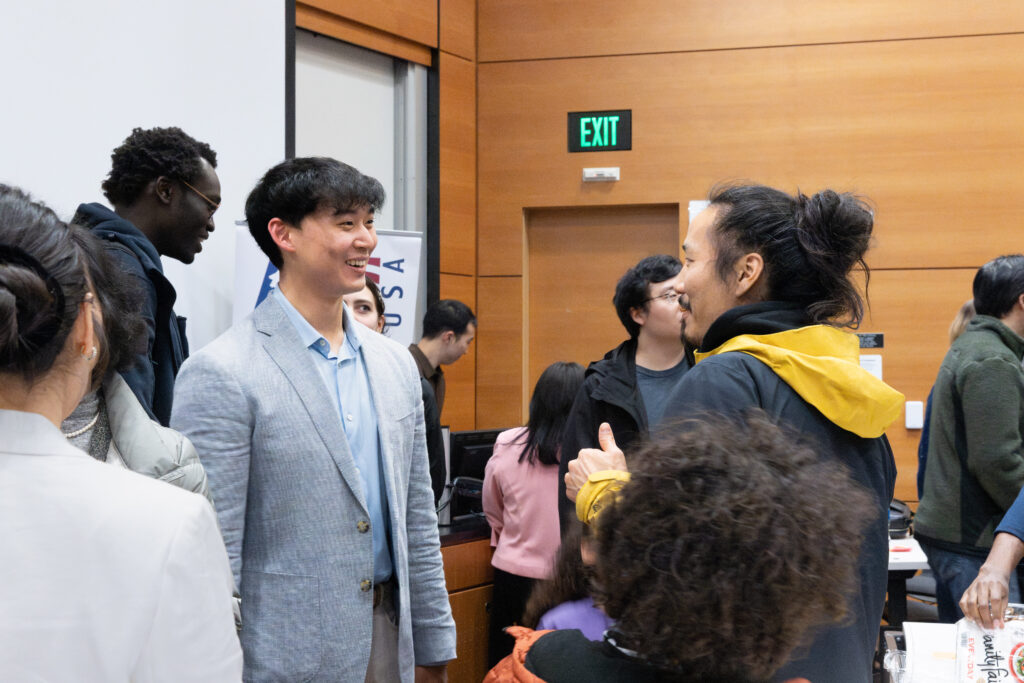
Audience at the AKU “Voices from North Korea” event at the University of Washington.

I could sense that most of the audience experienced a similar culture shock as Ms. Kim went on to describe the reality of the indoctrination and mental oppression faced by North Koreans. She asked the audience, “What would it be like if every decision was decided for you?” After a brief silence, she answered, “I don’t have to imagine,” because that was her entire life before escaping as a teenager in 2012 into China.

Ms. Kim recalled that after relocating to South Korea in 2016, some of her new friends asked her questions like, “What do you want to be?” She couldn’t answer because she had been trained from childhood to never think for herself, only to repeat answers that the regime had taught her.

This experience and journey of gradually “finding her voice” inspired her to pursue a career in education, because she saw that if the wrong education can control people, the right education can free them. She especially wants to help North Korean escapees see themselves as agents of change rather than as victims.

Hyunseung Lee was the other “voice from North Korea,” representing a different background and experience. While Jihyang grew up in poverty, coming from a farming family, Hyunseung was born into the elite class, with his father serving as a high-level government official.

However, even with certain privileges like having enough food to eat, the core issues related to restricted freedoms were the same. The entire ruling class also lives in a state of slavery, with every move monitored and controlled. Hyunseung described it as living in a “silver cage,” as opposed to the “iron cage” that the average North Korean lives in.

During his time in the North Korean army, he stated that approximately 50 percent of the time was spent looking for food and fuel, 30 percent was spent on ideological education, and only 20 percent was spent on actual training. It sounded more like an indoctrination camp than a viable military.
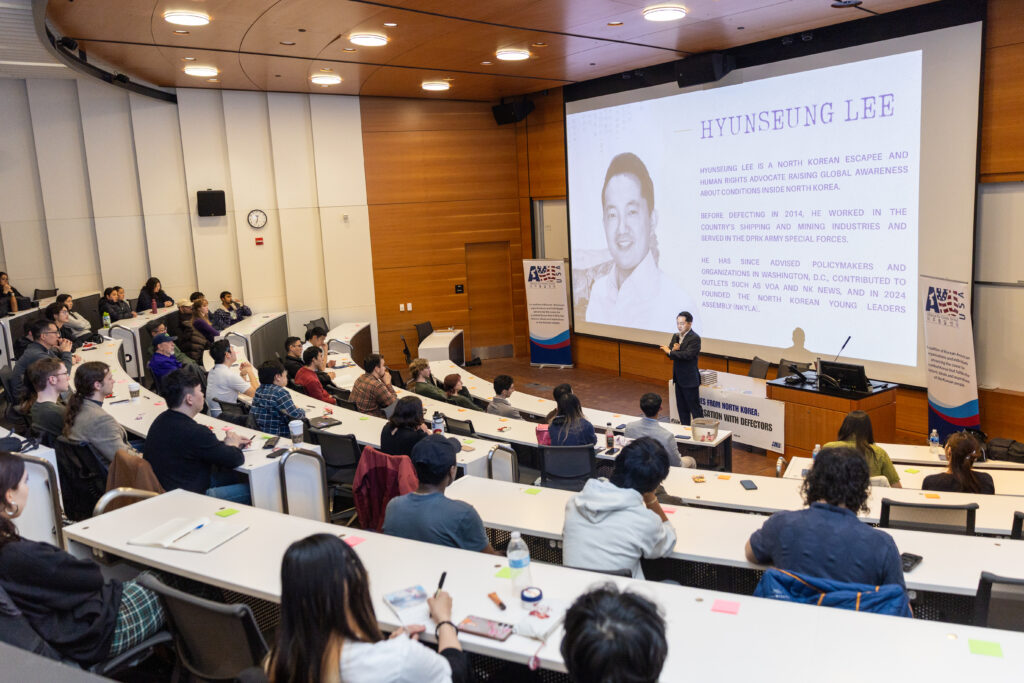
A speaker presents to an audience in a lecture hall at the University of Washington, with a large screen displaying information about Hyunseung Lee, a North Korean escapee and human rights activist, as part of the Voices from North Korea series.

Hyunseung Lee speaking at the AKU “Voices from North Korea” event at the University of Washington.

In 2013, when Kim Jong Un ordered the execution of his uncle and started a purge of all his relatives, Hyunseung realized that this was not the type of leader he could support. He eventually escaped to South Korea along with his sister in late 2014.

Most significantly, after moving to the United States in 2016, he realized that he had escaped not just for himself, but also so he could become an advocate for the North Korean people who are suffering.

It stood out to me that both speakers had concluded that they would use their newfound voices, not to present themselves as victims, but to speak the truth of the brutality of the Kim regime and to pioneer a way forward toward a free and unified Korean Peninsula, so that all Koreans and the world can prosper and benefit.

This sentiment was echoed by the emcee of the program, Mr. Namsik Yoo, director of Youth Programs at Alliance for Korea United, who presented a vision for a unified Korea called the Korean Dream. The vision is based on Korea’s historical founding philosophy, Hongik Ingan, or the virtue of living for the broad benefit of humanity. It was truly uplifting to see Koreans of various backgrounds holding onto the common ancestral ideal of Hongik Ingan by working together on this significant peacebuilding movement.
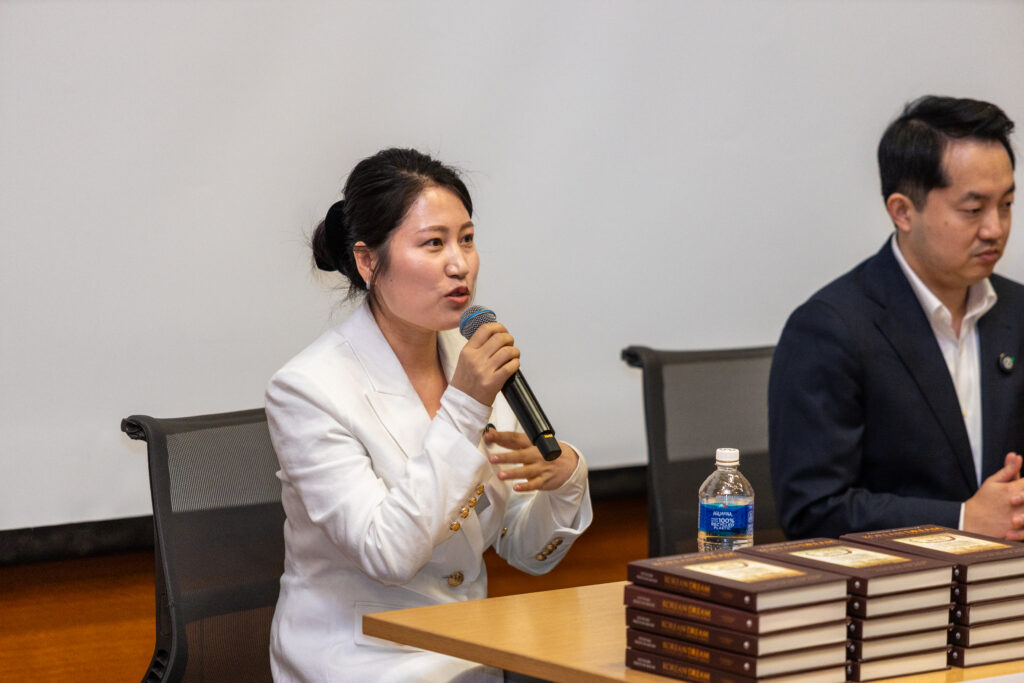
Jihyang Kim speaking at the AKU “Voices from North Korea” event at the University of Washington.

The finale, and the most inspiring part of the program for me, was an introduction by Mr. Shinhyun Kim to the ongoing activities of the campus chapter of Action for Korea United at the University of Washington. Shinhyun, a second-generation Korean American, is president of the club, which was newly established this year. He described the club as advancing the Korean Dream vision for a free, unified, and prosperous Korea. Recently, they held a movie screening of the film Danny from North Korea and supported Radio Free Asia’s efforts to share information with North Koreans.

The other club officers were introduced, and it moved me that there were young people who still have hope and are taking action for a unified and peaceful Korea, all the way here in Seattle, despite 80-plus years of division and many other major challenges obstructing the path.

The question-and-answer session that followed reinforced this feeling, as the packed audience of more than 80 attendees showed earnest interest in the Korean people’s plight. Questions covered the geopolitical concerns of reunification, the long-term effects of brainwashing on North Koreans, and a simple yet heartfelt, “Do you miss North Korea?” Mr. Lee answered with a sentimental and slightly remorseful, “In truth, yes, I do.”

In leaving the program, I felt confident that since the youth, especially the young leaders who organized this gathering, have not forgotten about the Korean Dream of a peaceful and free Korea, certainly I and the world will not soon forget these righteous Koreans who are seeking to bring their divided home and people together again. I will stand with them, and I encourage you to as well.

Sunday, May 17, 2026

New TaskRabbit review for installing a ceiling fan


Thank you for 5 stars Caryn!

Book your next home electrical repair here: https://www.taskrabbit.com/profile/nathan-b--46/category/63   

How a Millenial Gamer Came to Know God

This is my testimony re-posted from Family Peace Association's website.

It is said that God works in mysterious ways, and while I don’t want to discredit that perspective at all, I would also like to posit another seemingly contrary idea, that God works in very obvious and blatant ways as well. This concept does not quite appease the desire for awe-inspiring and miraculous experiences we sometimes seek from God, and yet I somehow sense that the in-your-face and perhaps mundane experiences we have with God might be the most important, especially as these are the experiences that are most relevant and meaningful in our daily lives.

In my own experience growing up, I can share that relating with God may not have been an intentional thought in my mind. Yet, in hindsight, I realize that God was certainly there and investing in me via the most personal and real way possible: through my familial relationships, especially through my relationship with my parents.

It’s not that my parents were the perfect embodiment of God’s love and goodness in every moment. Rather, it was through my efforts to properly relate with my parents in all of life’s difficult and complex reality that I eventually learned what it means to properly relate with God amidst a world of confusion.

As a typical millennial boy becoming a teenager in the early 2000’s, I had immersed myself in the world of video games and had little interest in the world of reality. The hours would fly by as I pursued victory in the go-to game of that time: Starcraft. Yet, one day, while I was in the midst of a major battle in cyberspace, my Mom came to me in tears in the midst of a mini-breakdown.

“I can’t do this anymore,” she wept.

I was struck as if by a bolt of lightning with a feeling of remorse like I’d never felt before. My mother had been slaving away at doing the dishes, caring for us four children and trying to make ends meet, and yet I was so consumed in intergalactic warfare that I hadn’t noticed any of her distress. In an unprecedented move, I walked away from the computer in the midst of a battle to the dismay of my online allies, and I helped my mom finish the household chores. To be honest, I even surprised myself. At a stage in life where honoring the sacred trust of friends even in a meaningless online video game was high on my priorities, I was still able to recognize that my responsibility to help my parents should take precedence.

A short while later I had a frank discussion with one of those friends whom I would frequently game with and together we made a pact to quit video games altogether for a year, both of us recognizing what a drain on valuable time they were. In that newly freed time and mental space, my consciousness of living for the sake of my family grew tremendously and I basically never went back into the gaming world.

I started to reflect on all the blessings our family had received when looking at the situation of the neighborhood around us. In the ghetto South End of Bridgeport, our family was comparatively much more well off than many others. This was true not only economically but also simply in the fact that we had a committed and virtuous 2-parent family. I began to practice more and more not only serving and appreciating my parents and family, but also finding ways to serve my community through simple actions like picking up trash on the street or helping out less fortunate families living nearby. My mother had helped me open my eyes to not only the situation of others, but also my enormous potential to serve and make an impact.

My father was not the type to dictate his children’s lives or make great demands on our behavior. Yet, in his own way, he would still challenge us to live up to our full potential. Through his own example of serving our family and the larger community, he would inspire us in all that we could do and with an occasional push, he would direct us towards what we should do. 

Volunteering in Central America

 Around the same time as my mother broke my ties with video games, my father also challenged me to get out of my comfort zone. He signed me up for a trip to Central America for three weeks, traveling to El Salvador, Guatemala and Honduras engaging in service projects in poor communities with an inter-religious volunteer team. It was an incredible experience where I could not only recognize more deeply my unique privilege on an international scale, but also make incredible breakthroughs in my own character and capacity to love others.

I am innately more reserved and quieter than most, and my parents would always prod me to make effort to talk more frequently and with more confidence. During this service trip, I exerted myself to find more ways to invest in others on my team and during the service activities by getting outside my shell. Yet what I experienced was honestly great disappointment and sadness as especially the members of the volunteer team I invested in revealed to me their own reality where they had little interest or sincerity in the goals of the project, basically taking the whole experience to be a vacation. Rather than becoming upset and lashing out at them or just ignoring the situation and minding my own business, I instead took time to pray to understand what was going on from God’s perspective. It was the first time I felt God’s painful heart so deeply as I was able to see my peers from a parental perspective and recognize not only the sad situation that they were in being unable to recognize where true meaning in life comes from, but also God’s desperate desire to awaken their inner potential.

It is often said that each person’s relationship with God is personal and unique, which I believe to be true, yet at the same time there is also an aspect to this unique and personal relationship that is unchanging and universally applicable, which is based on the principle that God is the Creator and we are the created, God is the source and we are the result. In that sense, one could say that the relationship we have with God is a vertical relationship such as that between a parent and child as compared to a horizontal relationship such as between friends. What better place to learn about our proper relationship with God than in our own families where God has given us the most intimate relationships to engage in. 

Nathan and his parents

 In my own experience and in my formative years, the efforts I made in my relationship with my parents is certainly what taught me the most in how to eventually relate with God. Parents provide the greater perspective and stability that allows children to overcome the strong force of peer pressure and their own insecurities. It is only a first step towards becoming the divine sons and daughters of God that we aspire for, but it is an important and necessary step. 

Thursday, June 27, 2019

It's amazing what God can do

It's amazing what God can do in such a short amount of time.

I recently directed a 3-day workshop for college students and young professionals. The theme was, "Building a God-centered Lifestyle, one step at a time". Going into this workshop, I was really nervous. Not only was it my first time directing a workshop, but I didn't know all of the participants coming. I didn't know what their perspectives were, why they were coming to this workshop. I knew I don't have the power to control how people think, and not having control over a situation can be a very scary thing.

Looking at the audience, it was apparent that people were coming in from all walks and stages of life. What was important, though, was what my mentors told our staff team. "Allow God to work through you."

Fast forward 3 days. It was hard to believe what I was hearing. Some participants realized the importance of thinking about God in their lives. Participants created action steps to build their relationships with God. Some started to recognize who they are as God's sons and daughters. Some found explanations for what they had been going through over the past year, and realized what God was asking them to do next. Myself included.

Some participants admitted that when registering for this workshop, they had their doubts. "What kind of outcome could come about in just 3 days?" So how did all of that happen? The workshop itself wasn't particularly extraordinary. The only thing that can explain it is that God exists, and is constantly present and working in our lives. This workshop was proof of that to me.  

-Maruko Breland


Friday, June 21, 2019

Capitalism in a nutshell

In our society, money represents value. So generally speaking, the more money you are making, the more value you are adding to society. In this perspective, it is basically your fellow man that determines how much value you are adding, not by lip service but by actually giving you their hard earned money in exchange for the value you are providing.

In this sense it is a bit strange that in a capitalist country like America people would accuse those who are rich of being greedy. Because in actuality those rich people are the ones doing the most for others.

Window shopping

Wednesday, June 19, 2019

A dynamic life and personal responsibility

The interesting thing about practicing free will and having the ability to make your own decisions is that you also become responsible for the outcomes. And yet the tendency in our society is to try to limit human freedom because we don't like the outcomes that we see, so we impose an excessive amount of regulations to limit freedom to make these bad decisions. Yet the way I see it, these regulations do not end up actually helping the situation - they don't trust people with responsibility and thus they try to set up physical barriers without addressing the root issue. 

In the end the only way to improve outcomes is to have people to learn from their mistakes. This means giving them the freedom to make mistakes but then holding them accountable for the outcomes. Not only is this the natural way that people learn, it is also what allows for a dynamic life where one can realize their full potential.